Across rural Europe, a quiet crisis has been unfolding for decades. Organic farmers face the compounding pressures of climate change, declining incomes, and market fragmentation, while struggling to access the digital tools that other sectors take for granted. At the same time, the governance structures needed to coordinate across regions, sectors, and national borders remain underdeveloped. The result is a fragmented landscape where the promise of sustainable agriculture is too often unrealised.
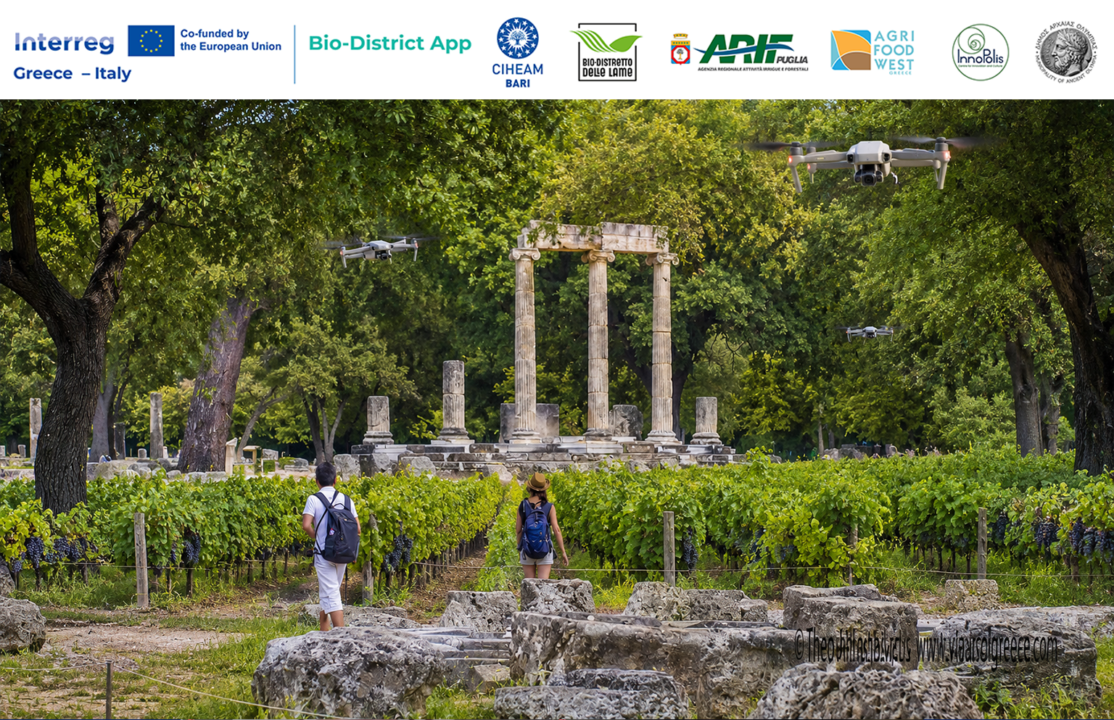
The BIO-DISTRICT APP project, funded under the Interreg VI-A Greece–Italy 2021–2027 programme, is one concrete response to this challenge. Over 24 months — from June 2025 to June 2027 — six partner organisations from Greece and Italy are working to design and deploy a common cross-border digital platform for organic farming communities in two pilot territories: the Biodistretto delle Lame in Puglia, and the Municipality of Ancient Olympia in Western Greece.
What is a Bio-District?
A Bio-District is more than an administrative boundary. It is a defined territory where farmers, citizens, public authorities, and tourism and food operators sign a formal agreement to manage local resources according to organic principles. At its best, a Bio-District integrates certified organic production with sustainable food systems, agri-tourism, and cultural identity — creating a coherent, place-based approach to rural development.
The model has proven effective in several Italian regions, and the BIO-DISTRICT APP project aims to accelerate its adoption in Greece, while deepening the collaboration between the two countries on shared challenges and shared digital infrastructure.
“The best solutions grow from the ground up. That is why we chose Living Labs — because the farmers, citizens, and local stakeholders are not the end-users of our platform. They are its co-authors.”
Living Labs as a methodology for co-design
Central to the project’s approach is the Living Lab methodology — a framework for open innovation that operates in real-world contexts, integrating research and development with the direct participation of end users. Rather than designing a platform in the abstract and then seeking adoption, the BIO-DISTRICT APP project establishes two Living Labs — one in Puglia, coordinated by CIHEAM Bari and the Lame Bio-District, and one in Western Greece, coordinated by InnoPolis and AGRIFOODWest — where stakeholder engagement, needs assessment, co-design sessions, prototype testing, and pilot validation happen in sequence.
This iterative process ensures that every digital service developed is grounded in real stakeholder needs and validated in authentic field conditions before any attempt at scaling. It is a slower, more demanding approach than top-down platform development — but it produces solutions that communities actually use.
InnoPolis’ role in the project
InnoPolis — Centre for Innovation and Culture is the Greek partner responsible for communication and dissemination across the project (WP2 Lead), and plays an active role in the co-design of digital services (WP4) and pilot testing (WP5). In Western Greece, InnoPolis coordinates the Living Lab in Ancient Olympia, bringing together local organic producers, agri-tourism operators, municipal authorities, and civil society organisations in a structured process of collaborative design.
InnoPolis brings to this work a decade of experience in European-funded projects at the intersection of digital transformation, rural development, and organic agriculture — including the predecessor ORGANIC ECOSYSTEM project under the ENI CBC 2014–2020 programme. That earlier experience informs the current work directly, both in terms of methodology and in terms of the relationships and trust that underpin effective cross-border collaboration.
Project at a Glance
6 Partner organisations across Greece & Italy
2 Living Labs in Puglia & Western Greece
24 Months of collaborative development
3 Platform languages: Greek, Italian, English
The digital platform: services for a sustainable agriculture ecosystem
The cross-border digital platform under development is designed to serve the specific needs of Bio-District communities: organic farm data management, certification support, market linkages, agri-tourism promotion, and knowledge exchange between producers and consumers. It will be available in three languages — Greek, Italian, and English — and is designed from the outset to be scalable and adaptable beyond the two pilot regions.
The platform is not conceived as a finished product handed over at project end. Its governance model — anchored in a Memorandum of Understanding between partner organisations — is intended to ensure continuity beyond the funding period, with potential integration into national agricultural digital systems as a longer-term aspiration.
A pathway from pilot to pan-European impact
The BIO-DISTRICT APP project fits within a broader strategic vision for the development of a Mediterranean bio-district network. In the short term, the platform will be opened to wider regions beyond the two pilot areas; in the medium term, ERDF and ESF follow-up proposals are being prepared; and in the long term, the goal is to contribute to a replicable, open-source model for bio-district digitisation that can be adopted across new Interreg areas and, eventually, at the EU level.
Synergies with other European initiatives — including CODECS under Horizon Europe, GRASS CEILING through CIHEAM, and CERV Magna Graecia — reinforce the project’s position within a wider ecosystem of rural innovation, and create pathways for learning and replication that extend well beyond its immediate geographic scope.
Project Partners
CIHEAM Bari Italy — Lead Beneficiary
Biodistretto delle Lame Italy
ARIF Puglia Italy
AGRIFOODWest Greece
InnoPolis Greece
Municipality of Ancient Olympia Greece
The BIO-DISTRICT APP project is co-funded by the European Union under the Interreg VI-A Greece–Italy 2021–2027 programme. For more information, visit www.innopolis.org or www.greece-italy.eu. Interested in collaboration or replication? Contact InnoPolis at info@innopolis.org.