
Crossing Borders for Ideas That Grow Communities
25 June 2026
FUTURE-ART Consortium Meets in Lisbon to Shape Art-Driven Fight Against Human Trafficking
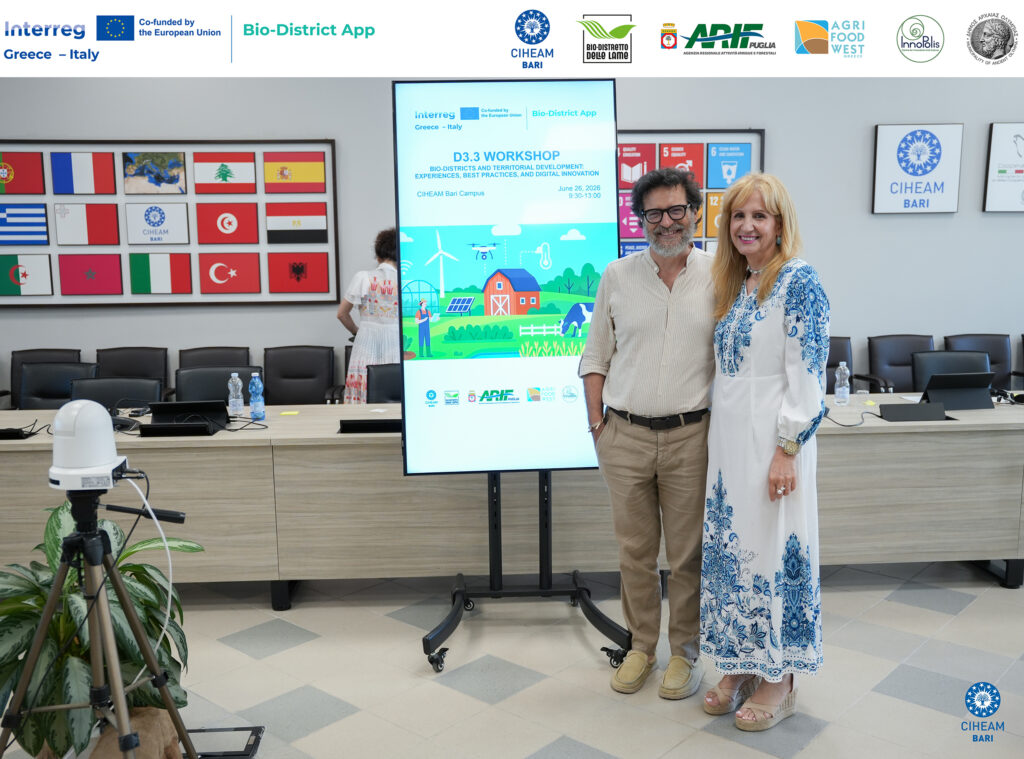
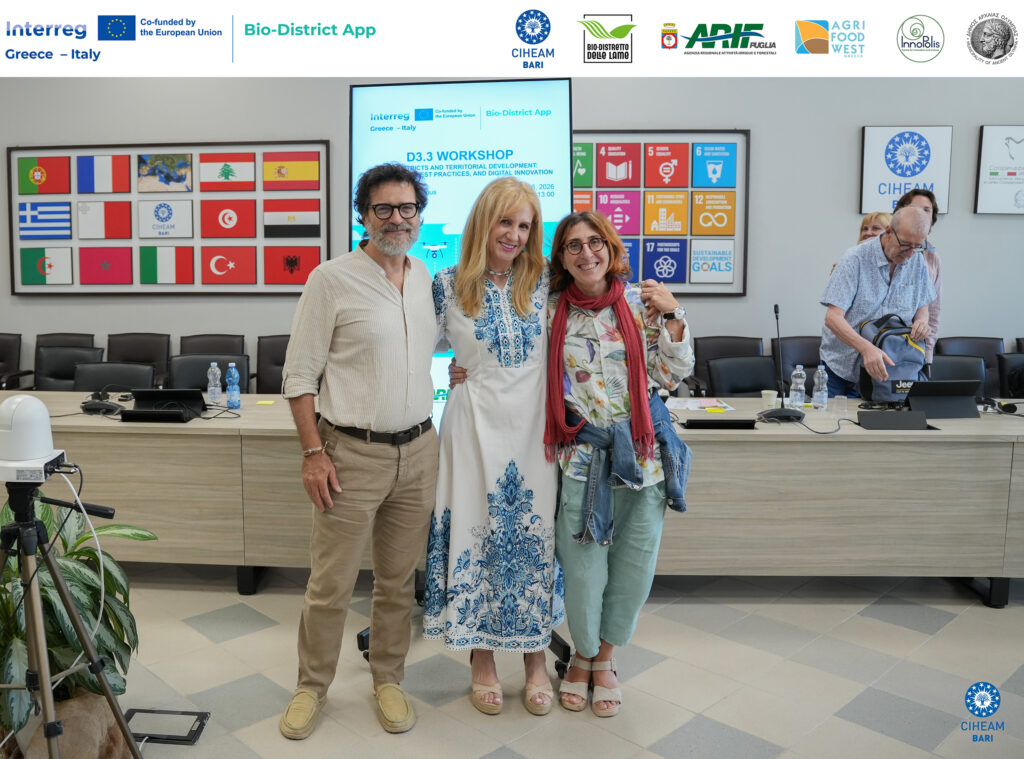
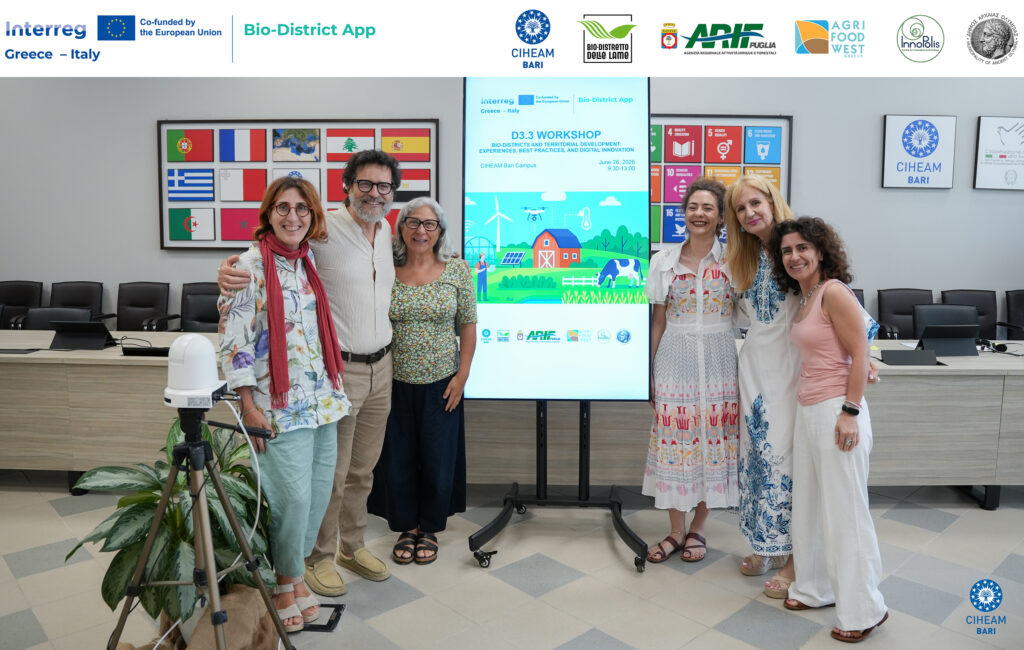
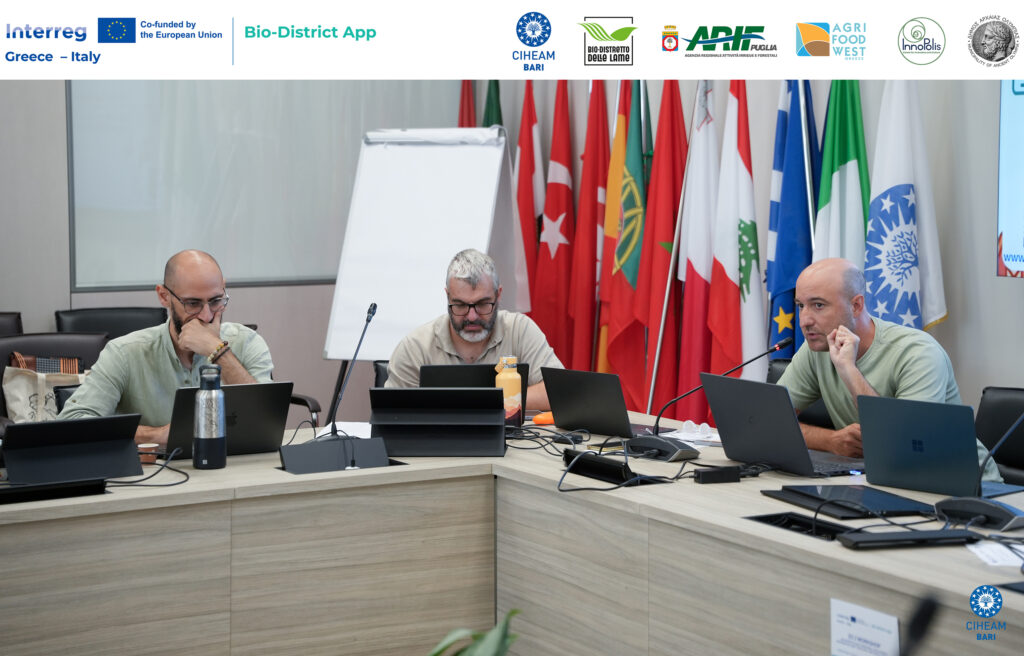
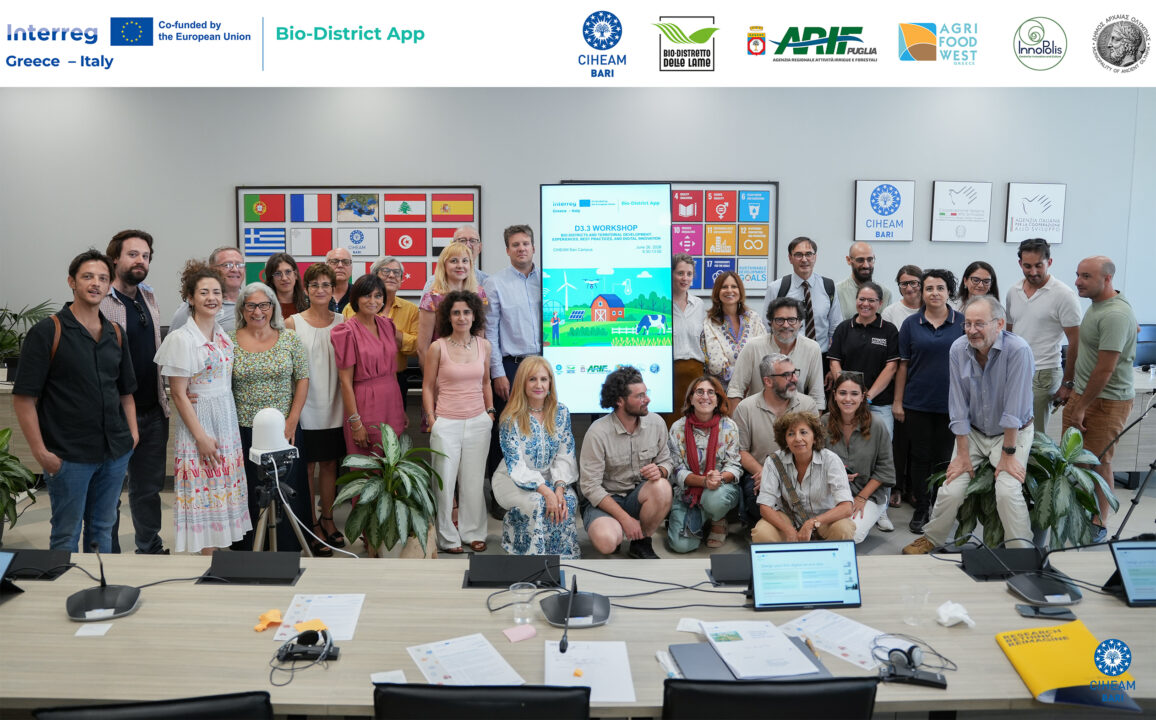
3 July 2026Report from the BIO-DISTRICT APP D3.3 Cross-border Workshop

Interreg VI-A Greece–Italy 2021–2027
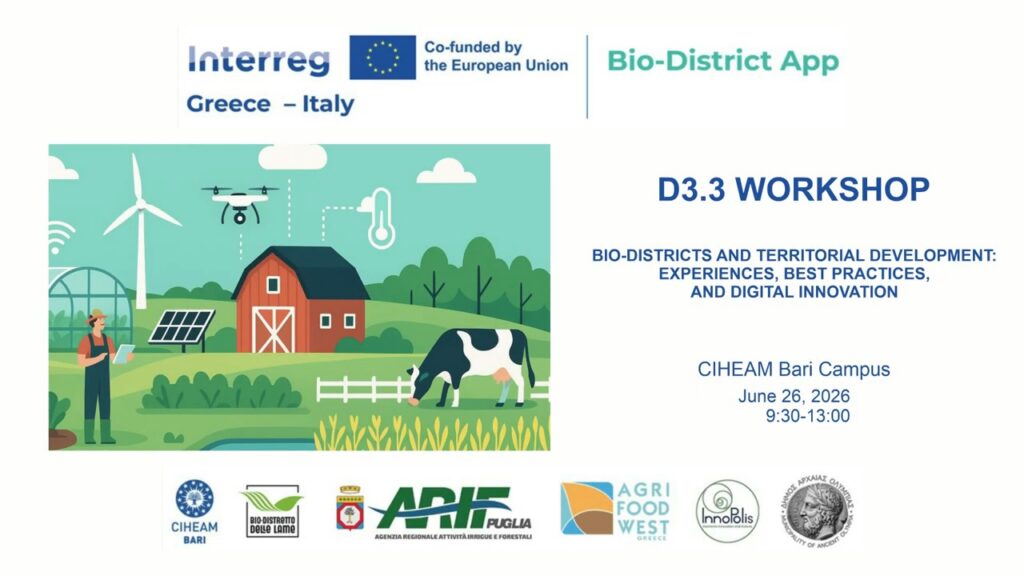
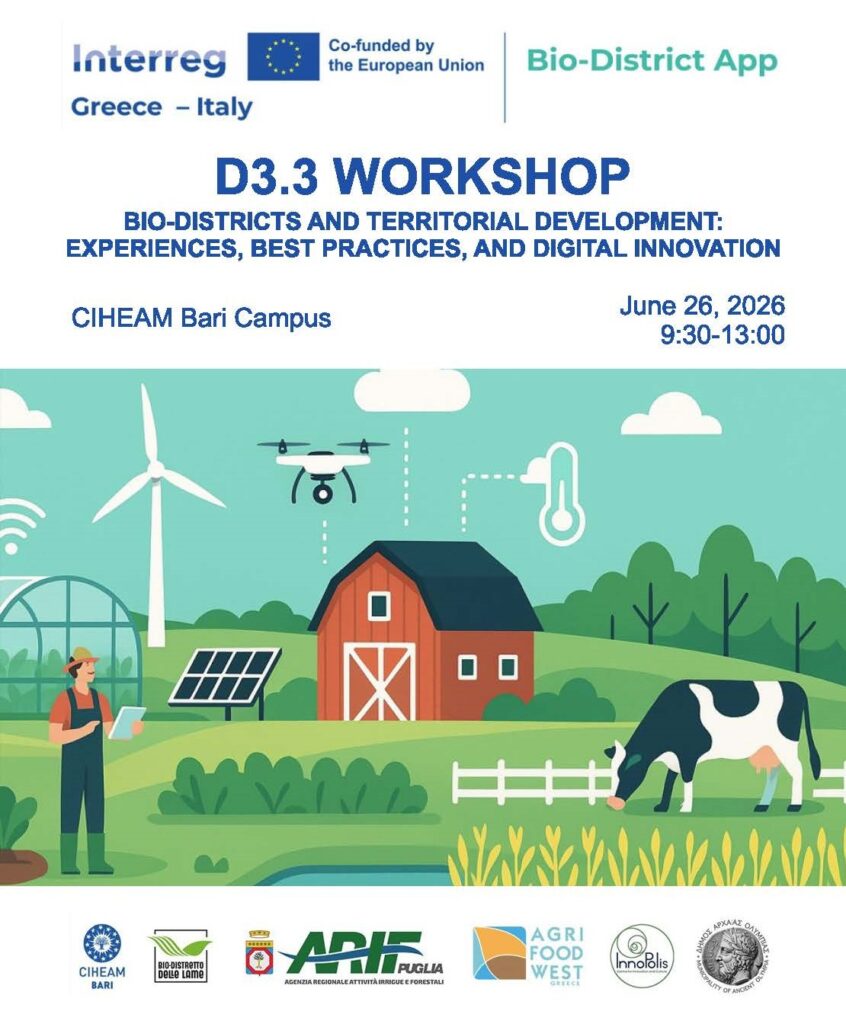
CIHEAM Bari, 26 June 2026
| Project | BIO-DISTRICT APP |
| Programme | Interreg VI-A Greece–Italy 2021–2027 |
| MIS | 6005158 |
| Workshop | D3.3 Cross-border Workshop |
| Date | 26 June 2026 |
| Venue | CIHEAM Bari Campus, Valenzano (BA), Italy |
| Authors | InnoPolis – Centre for Innovation & Culture (PP5) |
| With | AgrifoodWest / Region of Western Greece (PP4) |
Co-funded by the European Union
ABSTRACT
The BIO-DISTRICT APP project (Interreg VI-A Greece–Italy 2021–2027) aims to design a cross-border digital ICT solution connecting the bio-district communities of Ancient Olympia (Western Greece) and the Biodistretto delle Lame (Apulia, Italy). Within Work Package 3, Deliverable 3.3 calls for the exchange of best practices on ICT services addressed to local communities. The cross-border workshop held on 26 June 2026 at the CIHEAM Bari Campus brought together project partners, researchers and stakeholders to share operational experiences from Italy and Greece, examine fourteen verified international cases, and co-design the first ideas for digital services responding to the needs expressed by the Lame Biodistrict community. This article summarises the workshop methodology, content, and main outputs.
1. Background and Rationale
Bio-districts are territorial systems in which organic farming, agri-food production, tourism, and cultural heritage are jointly developed by local stakeholders following the principles of agroecology and community participation. Information and Communication Technologies (ICT) can support these communities by lowering transaction costs, increasing visibility of producers and territories, facilitating peer-to-peer knowledge exchange, and connecting public and private actors around a shared identity.
The BIO-DISTRICT APP project addresses four thematic dimensions identified as core to bio-district life:
- Organic farming and agri-food systems;
- Tourism and agritourism;
- Arts and cultural heritage;
- Community engagement and territorial identity.
Deliverable D3.3 — “Exchange of best practices on ICT services addressed to local communities” — is designed to provide a structured opportunity for the project partnership and external stakeholders to learn from operational experiences before the final ICT solution is specified.
2. Workshop Objectives and Format
The workshop pursued three operational objectives:
- To share, between Italian and Greek partners, mature digital initiatives already serving local agri-food, tourism and cultural communities;
- To benchmark these initiatives against verified international cases, selected for operational maturity and direct relevance to the territories addressed by the project;
- To translate insights into the first concrete service ideas through a structured co-design session.
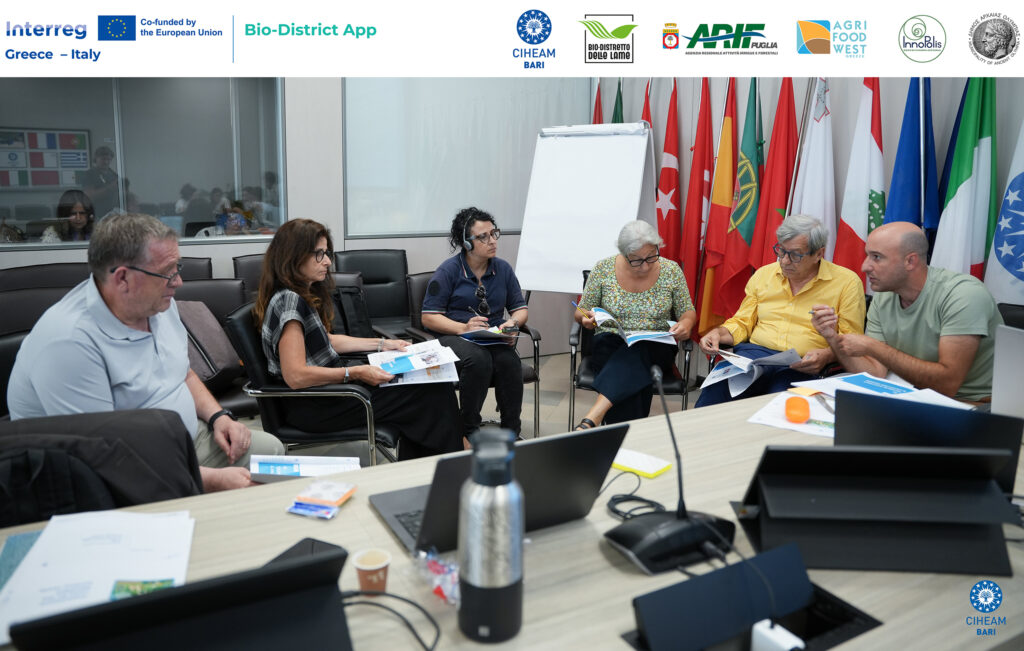
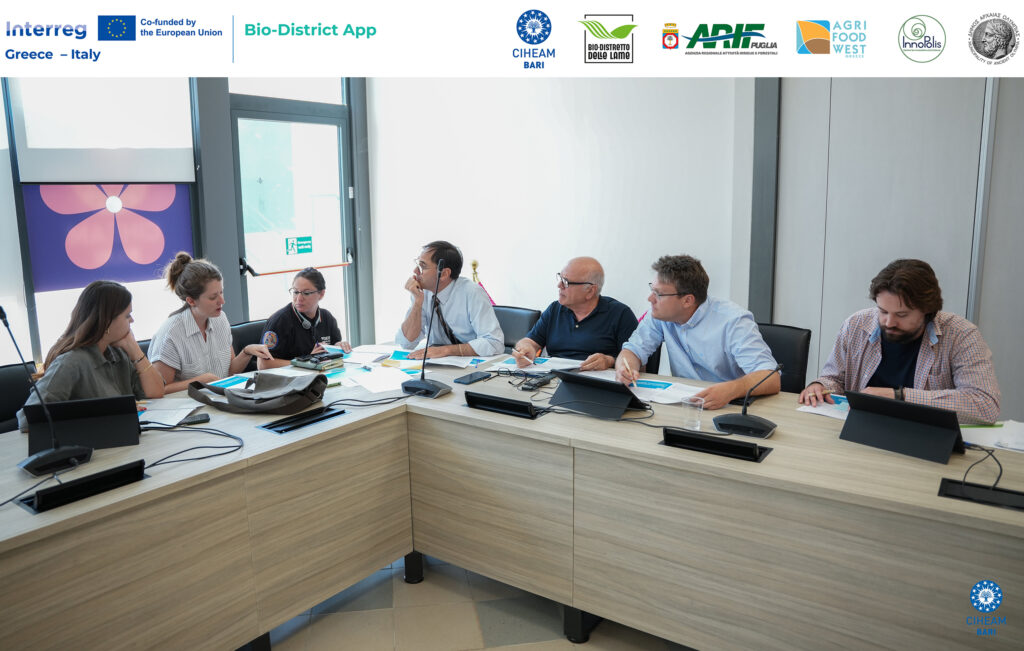
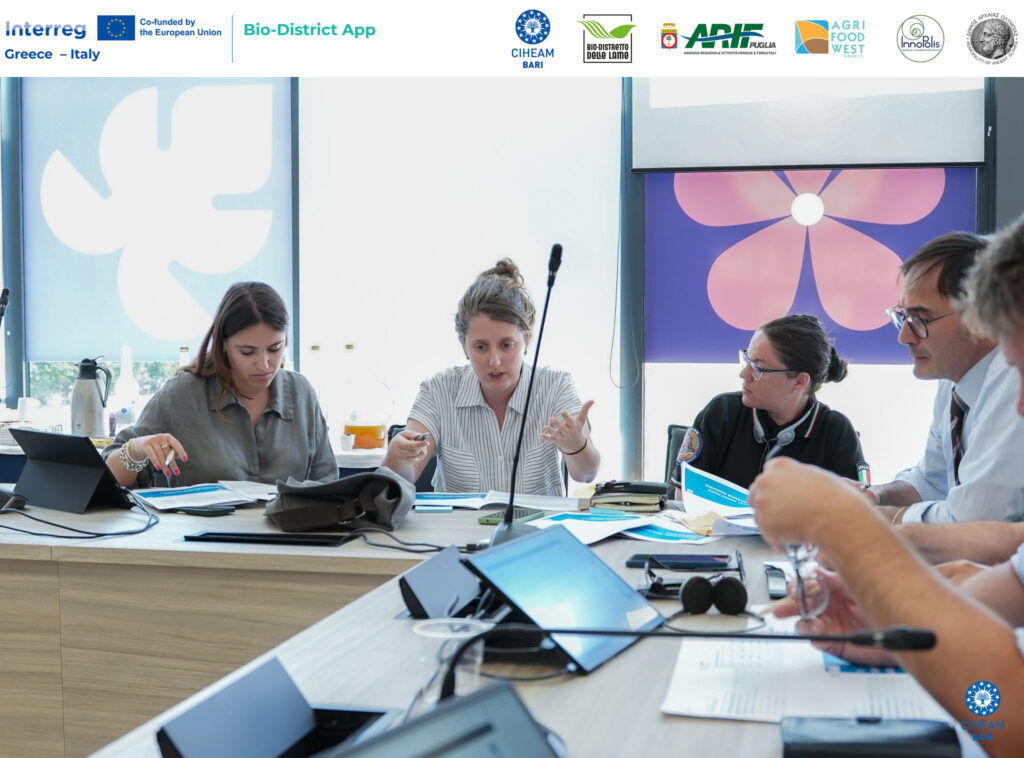
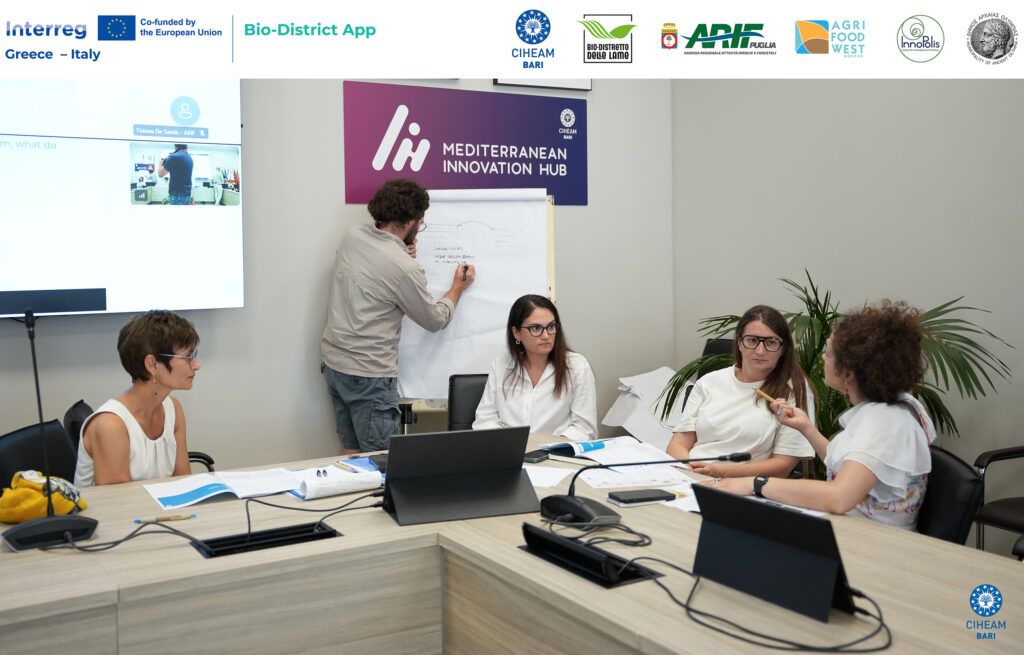
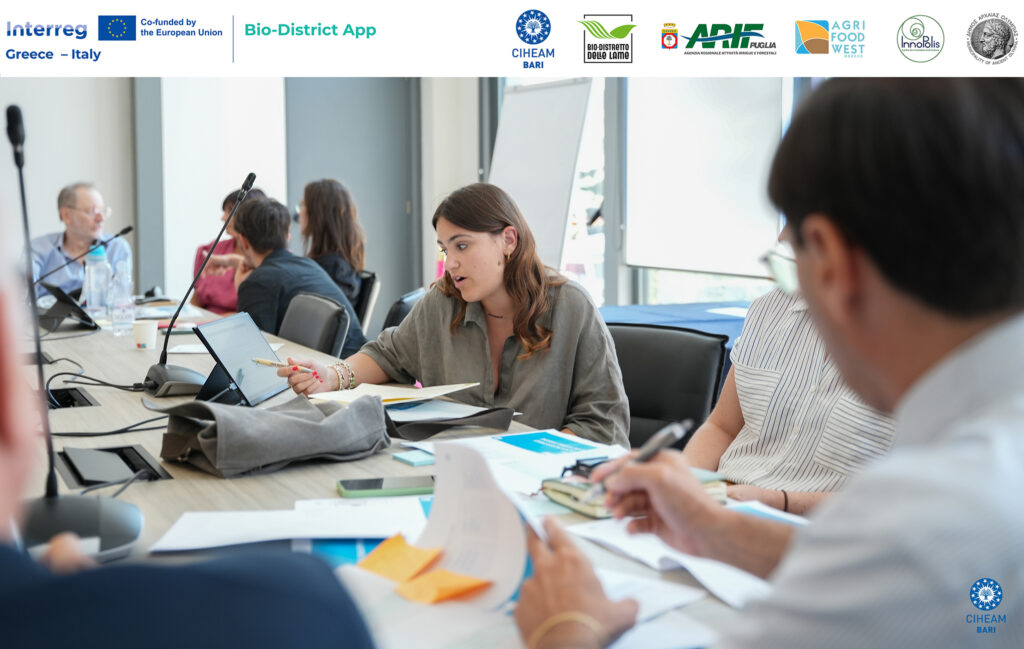
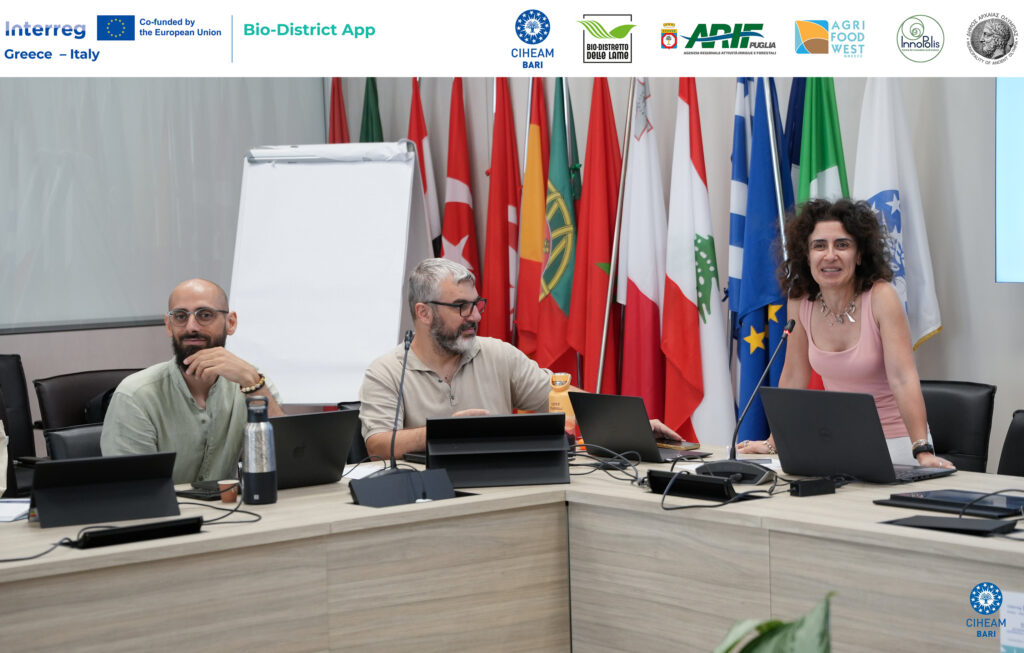
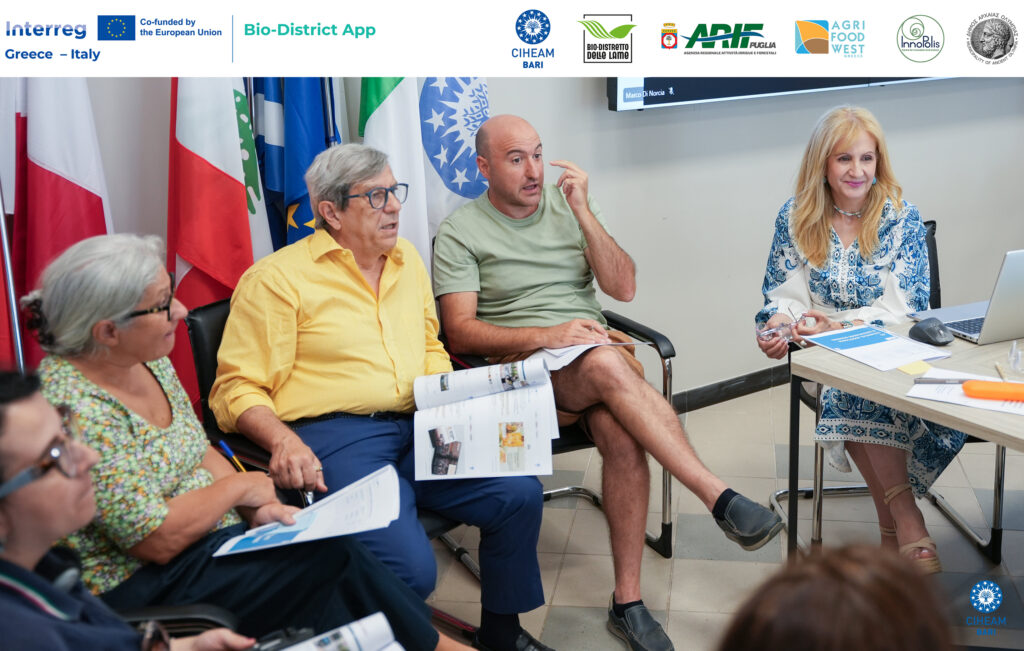
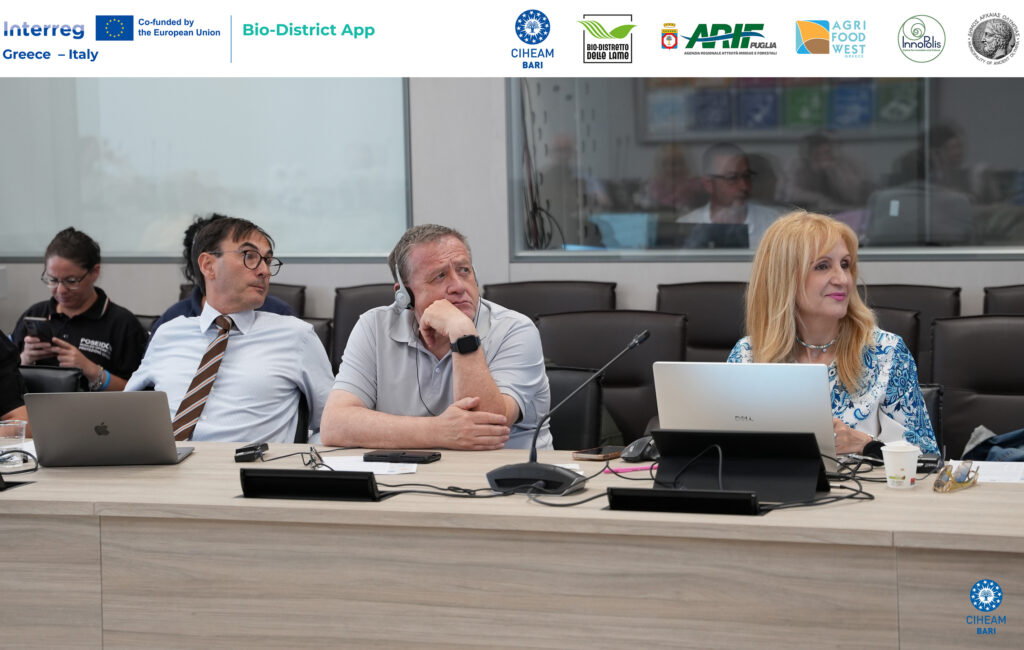
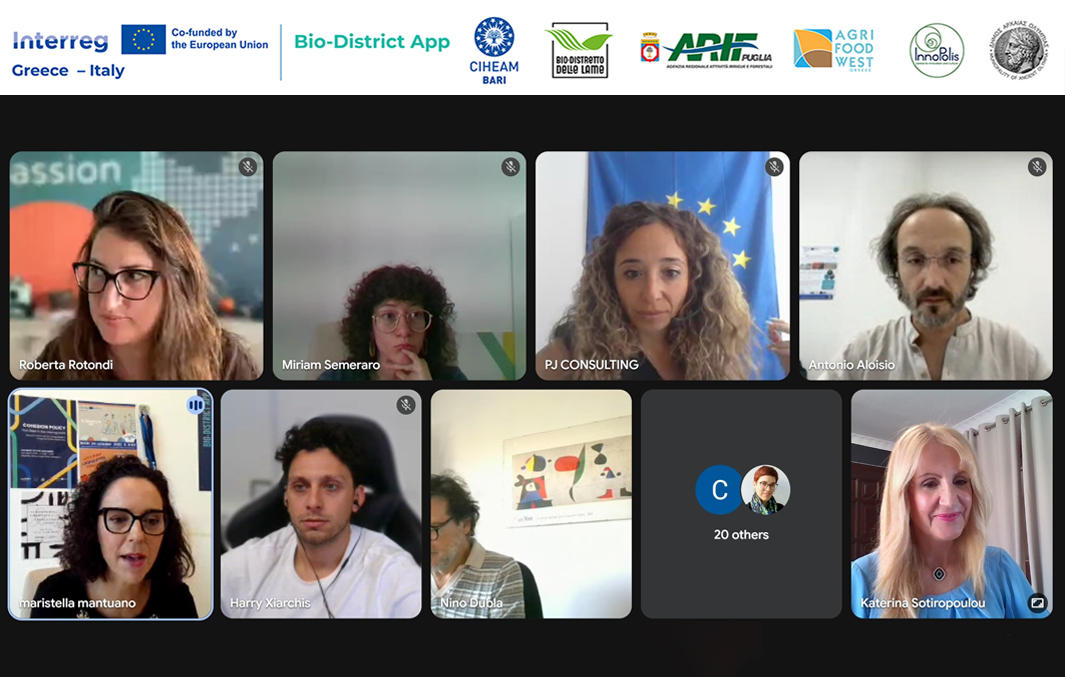
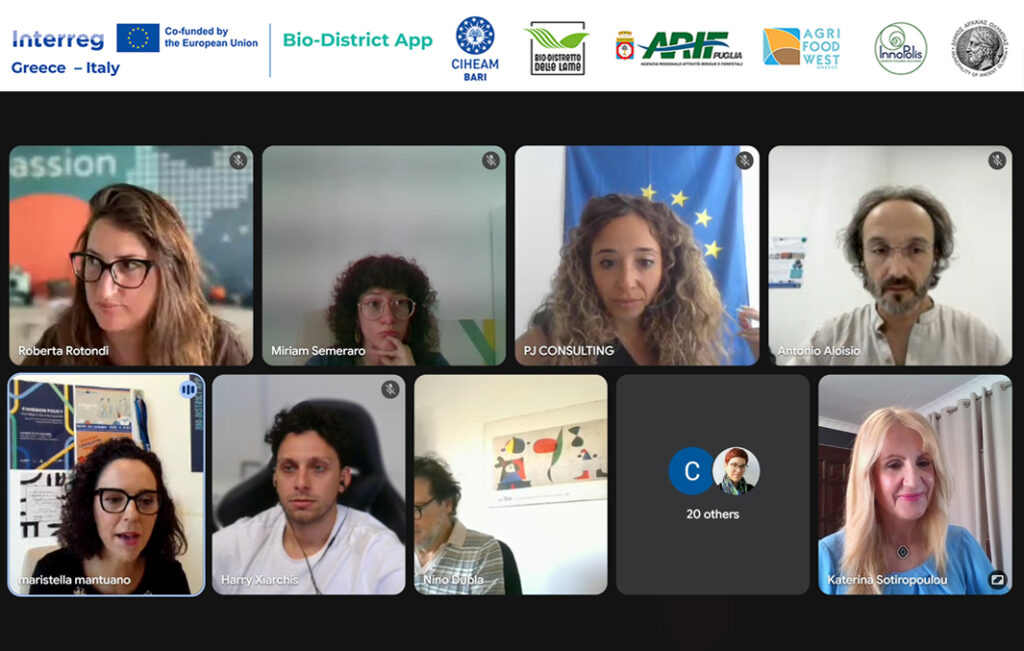
The format combined plenary presentations, a thematic deep-dive on the needs of the Lame Biodistrict, a warm-up reflection, and a co-design exercise in small groups. Sessions were held in person at the CIHEAM Bari Campus and made available online via Zoom for distant participants.
3. Workshop Programme
The full programme of the day combined morning plenary sessions with an interactive afternoon co-design exercise. The Greek joint contribution by PP4 and PP5 is highlighted below.
| Time | Session |
|---|---|
| 09:30 – 10:00 | Welcome note and introduction |
| 10:00 – 10:15 | Geolocation of the herd in the Val di Vara Biodistrict |
| 10:15 – 10:30 | Exploring technology for biodistricts |
| 10:30 – 10:45 | Best Practices from Greece (joint contribution PP4 AgrifoodWest + PP5 InnoPolis) |
| 10:45 – 11:00 | Coffee break |
| 11:15 – 11:30 | ICT in the promotion of the territory — Apulia example |
| 11:30 – 11:45 | BIO-DISTRETTO APP — Results of the needs assessment in the Lame Biodistrict |
| 11:45 – 12:00 | Inspirational cases for the identified territory needs |
| 12:00 – 12:15 | Warm-up conversation |
| 12:15 – 12:45 | Co-design session |
| 12:45 – 13:00 | Conclusions and next steps |
| 13:00 – 14:00 | Light buffet |
4. Needs Assessment of the Lame Biodistrict
The CIHEAM Bari team presented the results of the consultation carried out with stakeholders of the Lame Biodistrict, structured along two of the project’s thematic dimensions. The four top-ranked needs in each dimension are highlighted in colour.
4.1 Agrifood and Organic Agriculture
Stakeholders ranked digital needs in the agri-food domain as follows:
| # | Need cluster | Points |
|---|---|---|
| 1 | Technical assistance and sharing of agronomic good practices | 23 |
| 2 | Informing and educating consumers about organic products | 19 |
| 3 | Territorial valorisation — portals, mapping, tourism monitoring | 15 |
| 4 | Increasing product sales — marketplace, e-commerce, demand/supply tools | 12 |
| 5 | Exchange of products and services between producers | 9 |
| 6 | Valorisation of organic products — QR codes, traceability, transparency | 7 |
| 7 | Data and information sharing — DSS, sensors, real-time alerts | 6 |
| 8 | Mapping and census of organic farms in the territory | 5 |
4.2 Arts, Culture and Tourism
In the cultural and tourism domain, the ranking of digital needs was as follows:
| # | Need cluster | Points |
|---|---|---|
| 1 | Mapping and geolocation of points of interest | 13 |
| 2 | Building a shared territorial identity — gamification, fidelisation, community | 12 |
| 3 | Alliance and communication between public and private operators | 8 |
| 4 | Promoting tourism and cultural activities — events, experiences, urban + rural | 7 |
| 5 | Strengthening skills and capacity of tourism and gastronomic operators | 5 |
| 6 | Mapping and valorising hospitality and accommodation services | 3 |
| 7 | Deepening knowledge and values of the territory | 0 |
These two ranked lists provided the demand-side anchor for the rest of the workshop, ensuring that case-study analysis and co-design exercises were grounded in stakeholder-expressed priorities rather than in supply-side assumptions.
5. Greek Contribution: ICT Services from Western Greece
InnoPolis (PP5), in joint contribution with AgrifoodWest / Region of Western Greece (PP4), presented the mature ICT initiatives already operating in Western Greece, organised around the four thematic dimensions of the project.
- AgrifoodWest — Regional Digital Ecosystem. A collaborative initiative of the Region of Western Greece promoting and connecting the regional agri-food ecosystem under a single digital identity, with functionalities for digital promotion of products, business networking, promotion of regional identity, and dissemination of knowledge.
- DigiWest — Digital Innovation Hub. A Digital Innovation Hub supporting digital transformation across 500+ enterprises, agri-food businesses, SMEs and start-ups through a structured pathway: diagnose needs → train and mentor → deploy digital tools → network and promote → monitor progress.
- WiseFarmer. A digital knowledge-sharing solution connecting generations of farmers through collaborative peer-to-peer learning, exchange of expertise and best practices, digital training, and learning communities.
- iFarma — Farm Financial Analysis. A cloud-based farm management application for small and family-run farms and agricultural advisors, providing production cost analysis, profitability assessment, farm data recording (with default values when records are missing), and interoperability with FiSpace and third-party FMIS tools.
- AGROTOUR. A representative example of projects connecting agri-food production with rural tourism and local heritage in Western Greece, with functionalities including interactive maps, route recommendations, promotion of points of interest, digital guiding services, and producer–visitor connections.
These solutions can serve as building blocks for a community-led bio-district in Ancient Olympia — a credible Greek counterpart to the experience of the Biodistretto delle Lame in Apulia.
The Greek contribution also reviewed international best practices in smart farming (GPS-guided tractors, agricultural drones for early stress detection), tourism digitisation (booking and offline audio guides, VR/AR previews) and cultural heritage (3D scanning, digital heritage initiatives, social media and farm storytelling).
6. Inspirational Cases for the Identified Needs
The CIHEAM Bari team selected and presented fourteen operationally live, verified cases, directly relevant to the territory’s identified needs, grouped into four clusters.
01 · Technical Assistance and Knowledge Sharing
- Agricolus (Italy). Precision-farming decision support system combining remote sensing, satellite imagery, weather data and agronomic DSS into a single ecosystem; freemium + SaaS business model.
- Ruumi (UK/Ireland). Free mobile app for farmers and B2B SaaS dashboard for food supply chains, with satellite biomass estimates and rotation planning.
- ProntoPro (Italy). Italy’s largest marketplace for professional services, applicable to connecting bio-district producers with agronomists and specialists; lead-generation business model.
02 · Marketplace and Short Supply Chain
- CrowdFarming (Spain, EU-wide). Leading D2C organic platform connecting nearly 10,000 producers with 2 million consumers through farm adoption, seasonal boxes and a digital farmers’ market.
- GoodSAM Foods (USA). Organic and regeneratively grown snacks sourced directly from traced smallholdings, with producer stories embedded in the purchase journey.
- Dirty Clean Food (Australia). D2C regeneratively farmed produce traced farm-to-fridge, with an annual public Regeneration Report.
03 · Territorial Mapping and Discovery
- Komoot (Germany, global). Community of 40M+ users co-creating georeferenced “Highlights” and curated route collections transferable to bio-district itineraries.
- Raisin (France). Discovery platform for natural wine and local seasonal food, covering the full enogastronomic chain (producer → restaurant → accommodation → events).
04 · Territorial Identity and Community Hub
- Nextdoor (USA). Hyperlocal social platform for verified geographic communities, demonstrating how a shared digital space can construct collective identity around a geographic unit.
- BASE Milano (Italy). Hybrid cultural centre combining coworking, residency, accommodation, F&B and a public cultural programme.
- Fox Point Farms (USA). Innovative “agrihood” community combining residential living with sustainable agriculture and community engagement.
- CascadiaNow! (USA/Canada). Building bioregional identity across a politically divided transboundary territory through lightweight digital tools and acting as a fiscal/organisational umbrella for grassroots projects.
The case selection criterion was rigorous: only operational, verified solutions with direct relevance to the territory’s expressed needs were retained.
7. Co-design Session
The co-design session followed a three-step warm-up — silent review of the 14 cases, personal choice of the most resonant case with a one-sentence rationale, and a round of shares without debate — and proceeded to small-group work (3–4 participants per group). Each group selected one need cluster from the workshop’s ranked results and worked through five guiding questions:
- Which need? — naming the specific cluster and identifying primary users;
- Which case inspires you? — selecting one of the 14 cases and specifying the feature or model to be adapted, and what would be changed for the local context;
- What does it do? — formulating in one sentence the digital service, the problem it solves, and for whom;
- Who uses it — and how? — describing a real user scenario from opening the application to obtaining the result;
- What makes it work here? — identifying one critical success factor for the Lame context and one risk or constraint to flag.
This structure ensured each group output combined a needs anchor, a transferable model, a clear service proposition, a realistic user journey, and an honest acknowledgement of local constraints — producing the kind of actionable starting points the project requires for the design of the BIO-DISTRICT APP.
8. Discussion
Three observations stand out from the workshop.
First, the alignment between the demand side (needs ranked by the Lame community) and the supply side (mature ICT solutions in Western Greece and internationally) is strong. The top need in agrifood — technical assistance and sharing of agronomic good practices — maps directly onto solutions such as WiseFarmer (peer-to-peer learning) and Agricolus (DSS and academy). The top need in arts and culture — mapping and geolocation of points of interest — maps onto AGROTOUR, Komoot and Raisin. This suggests that the BIO-DISTRICT APP can rely on validated building blocks rather than starting from scratch.
Second, the cross-border dimension is more than a procedural feature of Interreg projects: it enriches the design space. Western Greek initiatives (already operational at regional scale) and Italian initiatives (often more mature in cultural-hub formats such as BASE Milano or agrihood formats such as Fox Point Farms) bring complementary perspectives.
Third, the workshop confirmed the value of community-based digital solutions as a design principle: tools that let users participate, exchange and build the bio-district together — rather than top-down information channels — better fit the social fabric of bio-district communities and the territorial logic of the project.
9. Next Steps
The outputs of the workshop will feed into the next phases of WP3 and into the specification of the BIO-DISTRICT APP itself. Three priorities emerge:
- Translating co-design outputs into preliminary functional requirements for the cross-border app;
- Continued mapping of existing Greek ICT services (AgrifoodWest, DigiWest, WiseFarmer, iFarma, AGROTOUR) and Italian solutions to identify integration and interoperability opportunities;
- Communication and dissemination activities (WP2) to bring the workshop content back to local stakeholders in both territories, ensuring continuity between the Bari workshop and follow-up engagement.
10. Acknowledgements
The Greek partnership extends its sincere thanks to the CIHEAM Bari team — Marie Reine Bteich, Raffaella Bucci and colleagues — for the rigorous preparation, the warm hospitality and the high quality of the workshop. Thanks also to the photography and video team who documented the day, enabling the wider dissemination of its outcomes; to the AgrifoodWest team for the joint Greek contribution; and to all stakeholders, presenters and participants who took part in the discussion and the co-design exercise.
The BIO-DISTRICT APP project is co-funded by the European Union under the Interreg VI-A Greece–Italy Programme 2021–2027 (MIS 6005158).